As the world is becoming more technological and conformist, the labour market is constantly looking for factors that can make the difference. For many years, all economic resources were concentrated in “tangible” or “hard” things as money, products and instruments that allow companies to carry out tasks in the fastest way. Nowadays, rather than focusing on “things”, the labour market diverts its attention on all “intangible” or “soft” resources: humans. Talented people, thanks to their performances at work, become more valuable resources to invest in, thus a group of intrinsic and extrinsic attributes directly related to communication, psychological behaviours and relationships in society are factors that an employee needs to succeed in workplace. As the focus is now on people, the field of education plays a key role in building up and developing those skills and make students ready for the future challenging time.
Since soft skills are intrinsic factors in humans, some of them can be already part of somebody’s nature, examples are creativity or empathy, but different activities, driven by educators, can sharpen them. For that reason, the sector of performing arts should be constantly related to the field of education. Many researchers agree that thanks to practical disciplines, working on students’ psychological behaviour can develop personalities and lifestyle that people will find useful in future workplace. Indeed, performing arts keeps investigating limits and possibilities of communication. The greatest performer, Marina Abramović, concentrated her whole career on studying different means of communication by establishing a dialogue with her audience, through active listening, body languages or training the right tone, all key instruments to improve effectiveness in communication and consequently in relationships. There are plenty of theories about how these disciplines taught in schools can generate benefits for the students, both in personal and study life, such as the ability to communicate strongly their opinion or increasing self-awareness. Alongside with communication, Shelley Duval and Robert Wicklund, discussed that self-awareness can be explained as the right moment when people can focus their attention on themselves and think if their values and behaviours fit in the environment and how people become unsatisfied when those are unbalanced. Therefore, Eurich describes self-awareness as internal and external and in some culture is already part of the lifestyle. As self-awareness arises, motivation becomes stronger. Mullins describes it as a “driven force through which people strive to achieve their goals”; in a psychological point of view, mind works in target-orientated way, so people need to set achievement every day, moved by need or purpose of increasing value. Moreover, the researcher underlines that motivation has different levels and each of them influence people’s actions, and then he split them up in extrinsic and intrinsic motivators, in which the former includes all tangible rewards (a good grade in an exam) whereas the latter highlights intangible rewards, as they arise from the psychological sector of an individual, for instance the challenging feeling, the satisfaction etc… The intrinsic motivators lead people to grow internally, so teachers play a key role in planting the seed of motivation. In a psychological point of view, another skill that has always been underestimated is empathy. Together with motivation, empathy roots can be already planted in human nature, but it can also be trigged by external factors, by taking care of environment or vulnerable people. Nowadays, indeed, the term diversity has drawn attention to its manifold meanings, which integrate gender and race alongside with environment or disabilities and the future challenges, where Countries aim to succeed, are on how to become more inclusive and greener.
All these requirements in job market underline that people are part of a society that needs to be protected and that people were born as sociable creatures. In these terms,team working has become an essential soft skill to develop. In the past, Taylorism focused on individual motions, in order to carry out machinelike performance in the fastest period of time, but now, on the contrary, resources are, for instance, building up strong collaboration and cooperation by creating trust and comfort atmosphere among workers with different personalities, point of views and work goals. But, in order to keep their own identity in a team, creativity becomes a necessary soft skill to build up, perhaps the most important one for educators. The researcher Robison criticises how much the formal education homogenises students, in which maths and writing are more relevant than any other practical discipline. He argues that education system needs a revolution, where schools give more space for group activities, laboratories and practical activities. But creativity is also a key instrument to enhance flexibility both psychological and technical, since laboratories in school and any other practical classes train the brain to think out of the box and unleash new ideas. Indeed, employers focus their attention on employees who are willing to learn new skills. The so called “learning to learn competences” describes this desire to learn competences in students while educators aim to plant curiosity and level up abilities, by stimulating them or questioning their beliefs. This can be a foot in the door for critical thinking, a soft skill which makes see things clearly and rationally and understand the logical connections. Teachers should adapt their teaching methods by educating students to be well-informed and open minded.
In this fast-changing world, a core challenge for future employees is time management .The ability of planning daily work routine and understand the urgency of deadlines, in order to focus on increasing effectiveness and productivity are relevant factors that can also help to build up dependability, a soft skill based on trust between employers and employees. It shows the ability of an employee to carry out and delivery any kind of task requested, completely independent and in the fastest period of time. Dependability is indeed a mixed soft skill where critical thinking and time management perfectly works in harmony.
Nonetheless, these tips might be useless if employees are not dealing with stress, a real threat in workplace. Especially in sectors that are customers-oriented, such as healthcare or education, the stress level can arise quickly. In schools, the higher numbers of pupils in a class or the lack of interest are elements that can stress teachers out and become trigger factors which directly impact the individual performance, both with co-workers and students.
Finally, this brief introduction highlights how soft skill are related to society. The life learning programme (Erasmus) is the ideal opportunity for both staff and students to grow in people cultural awareness, by starting in early stages of their education. Sharing experiences, ideas and opinions with students from different cultures and lifestyle create a lifelong value in those who aim to become citizens of Europe.
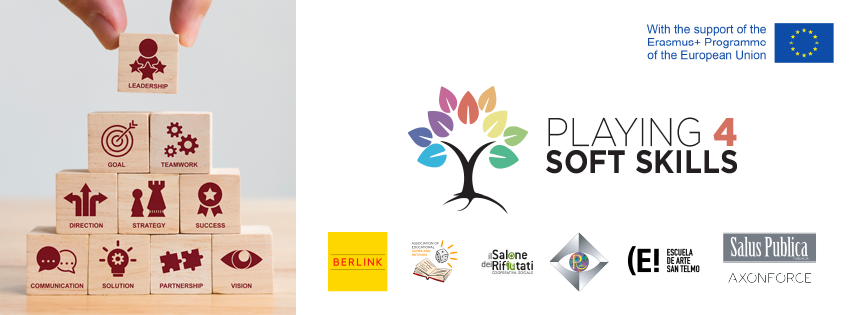
Thanks to the value that soft skills hold in students’ growth, the new Erasmus + “Playing 4 Soft Skills” project targets current VET students (aged 14-19) and teachers working within VET programmes across the European Union and it aims to improve students’ ability to recognize and develop relevant transversal skills by introducing non-formal education practices, both through games and digital tools, in the context of education and vocational training.
Go to https://playing4softskills.eu/, enter your email address, accept the general conditions and click on “Subscribe” to receive our newsletters and find out more about our project!