December 1, 2025

Bulgarian Students in Berlin Boost their Skills Digitally through Innovative Educational Project

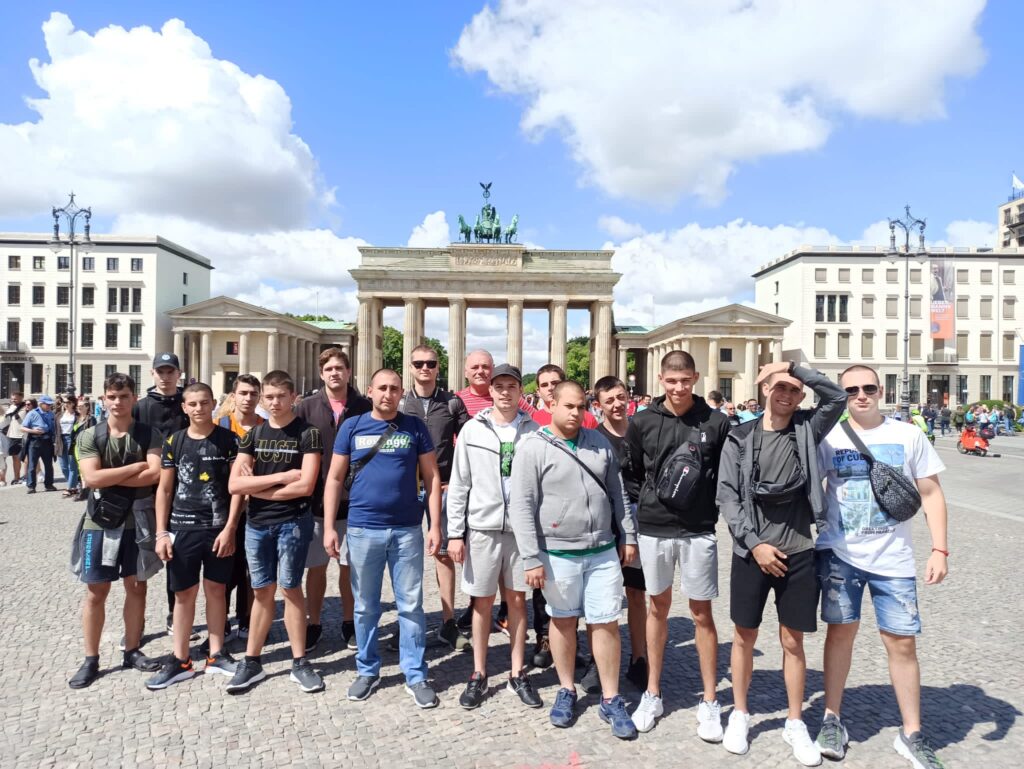
13 students from the Vocational school of transport “Prof. Tsvetan Lazarov” in Pleven, Bulgaria have become a shining example of the drive to understand and integrate advanced technology into modern educational systems. They completed a project of transformation and mind changing in Berlin as part of their involvement in the Erasmus+ mobility programme. This initiative titled “THE DIGITAL WORLD OF THE CAR – ELECTRIFICATION AND DIGITALIZATION” (Project № 2021-1-BG01-KA122-VET-000030895) was coordinated in partnership with Berlink ETN GMBH, an ETN Germany agency.

During the two-week mobility period, between 10 July and 25 July 2022, these ambitious students gained crucial real-working experience in 6 different car workshops in Berlin. Here, they learned the intricate details of diagnosing, repairing, and servicing electric and hybrid vehicles – a hands-on introduction to the world of the vehicle electrification and digitalization.

The students were not limited to the technical aspects of the automotive industry. The project also aimed to foster their key competencies and soft skills, while improving their language competencies and intercultural interaction, all invaluable components in today’s global economy. This was further facilitated by the rich cultural programme organised by Berlink.

The monitoring and validation of the students’ knowledge and skills was carried out by the accompanying teachers from the vocational school and the host partner in Germany, using the tools of the European Credit System for Vocational Education and Training (ECVET) and the EUROPASS certificate, the European standard for describing skills and qualifications.

The fruits of this educational journey have been numerous. By immersing themselves in a real working environment, the students not only gained professional competence, but also get acquainted with the latest automotive technologies. They had the opportunity to develop their entrepreneurial and social skills, which could serve as a steppingstone to starting their own businesses in the automotive service sector.

Moreover, the experience gained gives students self-confidence and ambition, thus facilitating their transition to the labour market. The international experience further enriched their understanding of other cultures, facilitated by language acquisition.

The long-term impact of this mobility is particularly significant. The introduction of dual education at the Vocational school of transport in Pleven and the implementation of new curricula focused on electric vehicles were launched. The successful completion of the project sparked increased interest from businesses in the Transport sector, with several students receiving job offers and invitations to continue their studies after graduation.

This innovative initiative is a testament to the effectiveness of incorporating emerging technologies into education. Artificial intelligence, robotics, coding, programming, and virtual reality are no longer the future – they’re here, and they’re increasingly becoming integral part of learning and development.

The “Digital World of the Car” project has shown that when we give students the right tools and opportunities, they can exceed our expectations and transform not only their future, but also contribute meaningfully to their chosen field. The enthusiasm and determination shown by these Bulgarian students is truly an inspiration that highlights the untapped potential of our youth to drive technological innovation forward.

This project has undeniably proved that with a hands-on, engaging approach to learning, combined with the introduction of digital skills and technological innovation, we can redefine education and prepare students up for long-lasting success in their future careers. The world is becoming increasingly digital – and these Bulgarian students are ready for it.
Related Posts

Just a few days left to apply your project to the Erasmus+ Programme

January 23, 2023

January 23, 2023

23 February at 12.00 (Brussels time) is deadline to apply for a short-term Erasmus+ project and participate in the European...

5 tips for an effective dissemination strategy for an Erasmus+ project

February 11, 2020

February 11, 2020

During the project evaluation phase, one of the quality criteria examined with greater attention regards the realization and management of...

Design’s Influence on Success: Insights from the “Design Me” Erasmus+ Project

September 15, 2023

September 15, 2023

We all know that design can significantly influence a company’s success, helping in brand building, attracting clients, increasing conversions, and...

Berlin: the European capital of future, innovation and human progress

September 20, 2018

September 20, 2018

An Italian PON student, Diego Briganti, sent us this article about his experience in Berlin at Berlink. Enjoy it! Berlin is the European capital of future, innovation and human...

ITT “E. Fermi” in Francavilla Fontana visits the Rhodes Town Hall. The “Rodiaki” article

July 11, 2025

July 11, 2025

The ITT “E. Fermi” in Francavilla Fontana carried out an Erasmus+ KA122 project in Rhodes with our Greek agency, Aristos....

Training – Experience – Welfare: the three key elements of any Erasmus Plus projects

May 10, 2021

May 10, 2021

After few weeks from the approval of the new 2021-2027 call of Erasmus Plus Programme, an important deadline is getting...

Job Shadowing in Rimini: an indelible experience for some Polish teachers at the Scuola Maestre Pie

March 27, 2023

March 27, 2023

Last week our agency in Rimini “Sistema Turismo” hosted a group of four teachers from Poland within the Erasmus+ program...

Erasmus+ KA2 IPAL project: news from last Transnational Meeting

April 7, 2022

April 7, 2022

The 4th Transnational Meeting of the Erasmus+ KA2 “IPAL – Improving Instructional Practices in Adult Learning and Supporting Adults Trainers’...

Erasmus+: the structured course for Bulgarian teachers on Google Workspace for Education and Interactive Teaching has just ended

July 28, 2022

July 28, 2022

Learning and enhancing the use of innovative teaching methods: this was the key objective of the European Erasmus+ KA1 project...

P.IR.A.M.iD: the project for the development of intercultural skills in the tourism sector

August 9, 2024

August 9, 2024

The P.IR.A.M.iD. project (Path for Intercultural Awareness, Measurement and Development) was promoted thanks to the ErasmusPlus programme with the aim...

Bulgarian school “Atanas Tsonev Burov” awarded for its Erasmus+ project on energy efficiency

December 17, 2024

December 17, 2024

Our partner, the Vocational School of Industrial Technologies “Atanas Tsonev Burov”, located in Ruse, Bulgaria, has been awarded a Quality...

SkillsAct4Vet: crossing results and widening impact

March 22, 2021

March 22, 2021

The debate around #SoftSkills has reached a central role during the last decade among the experts in training mobilities for...

Erasmus+ KA2 Mob4app project: the Berlink team and the Final Meeting in Madrid

September 15, 2022

September 15, 2022

As part of the Final Transnational Project Meeting, we as representatives of the Berlink team travelled to Madrid to meet...

Erasmus+ KA2: “Skills Act 4 VET” with wind in its sails

January 24, 2022

January 24, 2022

The “Skills Act 4 VET” project is gaining momentum for its last phase of development. With many goals successfully achieved...

Erasmus+: 2021-2027: first call approved

April 2, 2021

April 2, 2021

After a long wait, the European Commission has finally approved the first 2021 call of the new Erasmus plus programme...

Comments
Leave a Reply

Your email address will not be published. Required fields are marked *

Newsletter