Our work on Skills Act for Vet project is going on ! Despite the difficulties due to COVID 19 the project team is busy building the project products. We’ll provide a brief overview of the tools that the project team is creating and we’ll ask our teachers for help in testing a student questionnaire which
is part of one of the products.
We remind you that the products will be freely available to everyone.
Before describing our present work it is useful to summarize the project objectives and the expected products
Objectives
The project Skills Act 4 VET will move towards the following specific objectives:
• Designing a Transversal Skills Framework with a focus on
transversal skills that students can reinforce and develop during
short term work-based learning experiences abroad
• Developing and/or adapting tools, methods and resources
for an effective teachers’ training program fostering short
term VET mobility projects. Teachers’ training should aim at
encouraging students’ mindfulness;
• Defining methodologies and tools for wide use in European
students’ short mobilities
Products
1.Skills Act 4 VET preliminary research and identification tool : the extensive research aims at identifying the 5 most required or perceived as needed transversal skills by SMEs (host companies). Each identified transversal skill will be described by name, definition and indicators in the Skills Act 4 VET identification tool. In order to ensure a better understanding of the different skill characteristics, a set of micro-skills will be associated and described for each identified skill.
- Skills Act 4 VET Work-based Tasks Map: The VET Work based tasks map will be a simple tool expected to enhance students’ awareness and activation of transversal skills while they are at work.
This output will allow:
• The definition of a framework linking each of the identified
transversal skills to the workbased learning activities
• An elaboration of a set of behavioural elements for each
identified transversal skill: elements describing both adequate
and inadequate levels of skills activation.
• The set of behavioural elements will be used for creating
students’ questionnaires for self assessment. - Skills Act 4 VET Modular Training Programme for Teachers. One of the core outputs of the project will be the development and implementation of a structured training course for teachers supporting students’ awareness of their transversal skills activation process. The training programme is addressed to any VET school or organisation promoting transnational workplacement experience for their students and is delivered at three different times :
• Before the mobility takes place to effectively prepare the students for their learning experience
and provide them with first elements they will be invited to work on
• During the mobility in order to guide the students through the use of the Skills Act 4 VET Tasks Map and the Self Assessment App and monitor the progress of their learning journey
• After the mobility completion in order to allow them to assess the outcomes of their learning journey - Skills Act 4 VET Assessment Methodology and App It will be a self-assessment tool to explore the individual self perception and level of awareness around the targeted transversal skills. The app will assist students to become more effective in living and working. It will not just be a simple tool, it will be a real test, scientifically valid, that measures the achieved awareness and activation of the transversal skills. Where are we at?
The project group completed the extensive exploratory research in March 2020 (details at the following link http://adiscuola.it/the-results-of-the-survey-transversal-skills-activation-for-vet-mobilityexperiences/ ). Based on the investigation results, five competences emerged as the most important ones for employability : - CONTEXT READING and ADAPTABILITY : It is the ability to act properly in both new and known contexts, adapting to their specific characteristics and recognizing the values, beliefs, resources and limits of the environment and people. It is also the ability to recognize one’s own and others’ role expectations. In multicultural contexts, this capacity implies the linguistic-communicative adaptation to specific environment;
- SELF CONFIDENCE : recognizing one’s strengths and weaknesses;
- FOLLOWERSHIP: Supporting one’s own referent/superior and co-workers at the workplace and showing collaboration, trust in the group’s members and cohesion capabilities;
- CULTURAL AWARENESS : Respecting and being aware of cultural differences and working effectively with people from a range of different social and cultural backgrounds;
- PROACTIVITY: Acting in advance of a future situation, rather than just reacting to it. The project team described each skill using a set of behavioral indicators to complete the identification tool, then the project group chose the three most relevant behavioral indicators for each competence. This set of 5 competencies and 15 behavioral indicators formed the basis for developing the following products:
- The Skills Act 4 VET Modular Training Programme for Teachers: the project team is currently creating module one ( the module “before the mobility”). In module one teachers will find information, bibliography and activities about each of the five competences. Teachers will use the materials to activate and discuss the competences before the mobility.
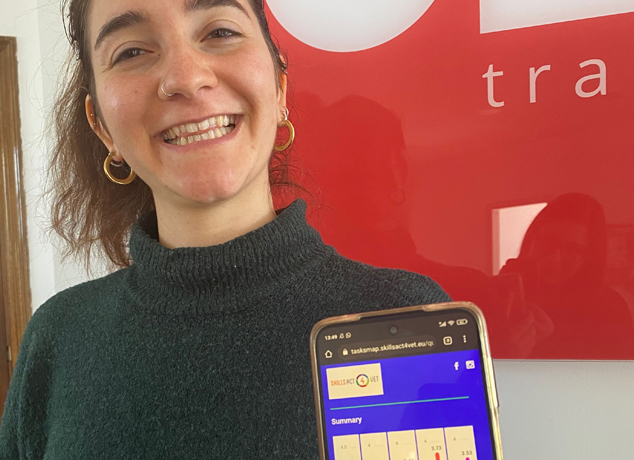
- Self assessment and evaluation tools: map of tasks at work: the project groups is using the set of behavioral indicators describing each of the selected competences to create a questionnaire linked to the job duties. Both students and internship tutors will answer the same questionnaires, students will be able to compare their self assessment with their tutor evaluation. The map of tasks at work will therefore serve as a self-assessment tool during the mobility. Students will use it, in itinere , as a track on how to optimize the mobility experience itself.
App: Students will answer another questionnaire using the app, this questionnaire will be drawn up by a team of psychologists. This questionnaire will have scientific value and will complement the task map at work. Students will use this tool to measure their degree of activation of skills achieved during the mobility experience and their level of awareness. The results of the questionnaires will represent a basis for discussions and reflections.
The app questionnaire needs to be tested to evaluate its degree of comprehensibility and adequacy. For this purpose we need your help, please test the questionnaire with your students. Below you can find links to the tests. The questions are the same, however one questionnaire is in English while the other one is in Italian. The questionnaires are online, they are aimed at students who have completed an internship abroad and they are very short. Thank you so much for your help!!
Link to Italian: Test
Link to English: Test