“Digital Education Materials for Sustainable Textile Education (Vir2TEX)” Erasmus Plus project held the final meeting
Ege students will learn lessons with VR technology
The final meeting of the Erasmus Plus project “Digital Education Materials for Sustainable Textile Education (Vir2TEX)”, which is prepared with the aim of increasing the knowledge level of students studying in the field of textiles with digital technologies and developing new learning materials for distance education, carried out by Ege University with national and international partners, was held.
Emel Akın Vocational School faculty member Prof. Dr. In the project carried out by Sevda Altaş, the students taught using VR 360 video glasses as part of the “Textile Manufacturing with the Innovative E-Learning Methods” course. Ege University Rector Prof. Dr. Necdet Budak said, “Prof. Dr. I would like to congratulate Sevda Altaş and all our teachers who contributed to the project and wish them success in their studies”.
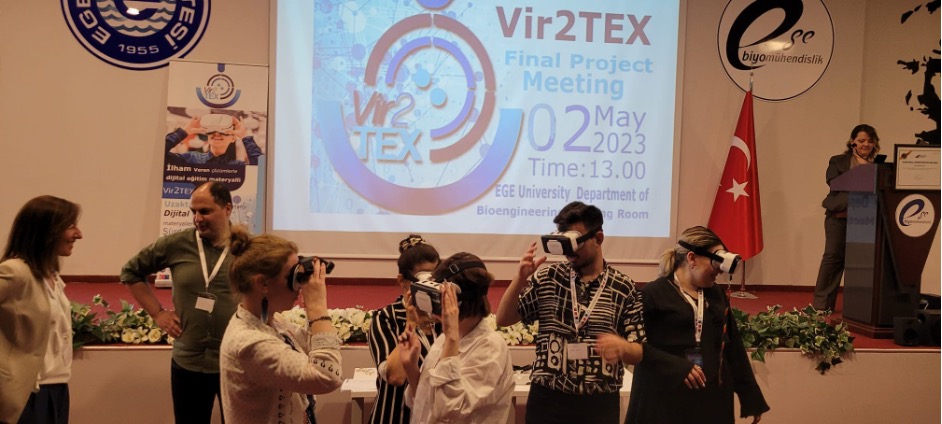
Emel Akın Vocational School faculty member Prof. Dr. Sevda Altaş, Yaşar University faculty member Murat Ertan Doğan, overseas project partners, academics and students attended. At the final meeting held, the participants were tested with the training contents developed with VR glasses.
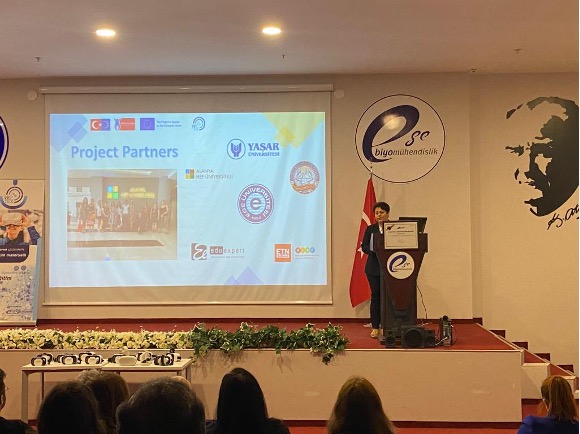
Giving information about the details of the project, Prof. Dr. Sevda Altaş said, “We aimed to provide new learning experiences by attracting the attention of students while teaching both in the classroom and distance education with the new educational materials developed. With this project, we eliminated the screen, placed students in the middle of real situations with VR 360 video and used the potential of virtual reality (VR) for better understanding and learning activity. With the videos prepared with professional voice over in the studio environment, our students can now get to know the production process and machines remotely without going to the factory. By creating 14-Week Training content within the scope of the project; a course in English, named ‘Textile Manufacturing Process from Fiber to Garment with the Innovative E-Learning Methods’ was created with the outputs of the project. For the first time, textile education was given to students by using innovative learning methods in Vocational School”.
“Our project will benefit institutions providing textile education”
Expressing that the outputs of the project will be beneficial for institutions providing education in the field of textile, Prof. Dr. Altaş said, “The target audience of this project is vocational school students studying textile, textile engineering and fashion design students. It consists of teachers, trainers and consultants who provide education in the field of textiles, those who have just started working in private companies producing textiles, students and educators who receive textile education in lifelong learning through sustainable learning and awareness. Therefore, this project will also be beneficial for other textile education institutions that do not have the infrastructure, but need to practice on many machines while explaining the subjects to the students during the education and training process. All teachers, students and people who want to improve themselves in the field of textile can easily access the project outputs free of charge. Nowadays, when we continue hybrid education with students, the educational materials developed are tested by Emel Akın Vocational School students and the contents are updated based on the feedback obtained from the questionnaires applied to the students. This course will be the first course to be conducted using innovative methods in a vocational school and will support future studies on this subject.”

The partners of the project, carried out under the direction of Ege University, are Yaşar University, Alanya Hamdullah Emin Paşa University, ETN School (Italy), Universitatea Religious Pıtesti (Romania) and Eduexpert (Poland). Uz Pamuk, Tepas Tekstil, Sun Tekstil and Ekoten companies supported the training contents prepared within the scope of the project. The developed training contents can be accessed from the web address “ https://vir2tex.yasar.edu.tr/ ”.