Why is non-formal education important?
Everyday life and professional activity in the 21st century often require us flexibility, creativity and the ability to make quick and rational decisions. There are no textbooks that would provide us with solutions covering all possible challenges and life scenarios. There are less facts for the students to memorize as these become obsolete relatively fast. There are no rigid rules and procedures one must follow to reach certain conclusions or finish a project, as nonstop developments and progress open up new possibilities, trajectories of thinking, sources of information and new people to listen to.

Formal education can be defined as a teaching approach which builds the foundations of students’ knowledge. In addition, however, education must also address the fast-changing issues, questions and concerns that students may want to ask their teachers about. Some of these issues have not yet found their place in the textbooks normally used in classrooms. Consequently, the key role of teachers must also be seen in a new light, since they should act as much more than suppliers of information, evaluators, and controllers of discipline. These three functions have often used a substantial amount of teachers‘ mental energy and classroom time, but it should not be that way!
In contrast, transfer of theories and education across various thinking approaches may happen through video resources which students have access to. One can easily check facts online and obtain only those that are needed in a given project. Evaluation via self-assessed online tests and uploaded assignments has become incredibly efficient and may also happen outside the classroom. The needs and expectations on controlling students’ classroom behavior have also evolved in recent decades and what was often considered as an „unruly“ behavior is now regarded as an expression of students‘ personalities.

Non-formal learning takes place across a diverse range of environments and situations for which teaching/training and learning are not necessarily the main activities. These environments and situations may be temporary, and activities taking place may be staffed either by teachers themselves, professional learning facilitators (such as youth trainers) or volunteers (such as youth leaders). Such activities and courses are planned in advance, but are seldom structured based on conventional rhythms or curriculum subjects. They rarely tend to document or assess learning outcomes or achievements according to conventional ways (such as through grades).
Non-formal education allows teachers to play an essential role as coaches, motivators, and facilitators. These functions are strongly supported by gamification, i.e. the evolving methodology of developing and using game elements and educational games, both traditional board and card games, but also those played on the digital medium. We hope that this Training Notebook will be helpful in providing teachers – who will be acting as facilitators – with the necessary tools to foster non-formal education in schools.
We describe here below some theoretical background explaining the rationale of our game-based approach (see also Appendix 1). We also explain in more detail the crucial role of facilitators: even though playing games is easy and fun, this becomes much more educational when the objectives and rules of the game are well explained and supported by friendly advice.
What is the game-based learning approach?
No matter whether you develop a city in a computer game, buy real estate on the board, play cards or just play scrabble – games make such abstract exercises more exciting. Playing a game becomes so attractive that it can completely absorb us. This is what gamification is all about!
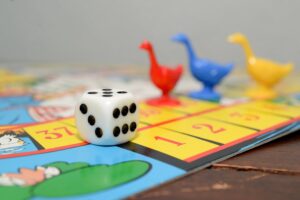
Such an approach uses game mechanics in order to encourage people to do things that they usually don’t feel like doing or are not aware that can be done differently. Gamification also helps in turning activities that are not particularly attractive or even boring into something that can catch our attention, making more interesting topics that normally have little to do with fun (like war or fighting). Moreover, it aims at using game elements in non-entertainment contexts so as to motivate people to perform certain activities, such as collecting information, analyzing data, or presenting results in visually attractive ways.
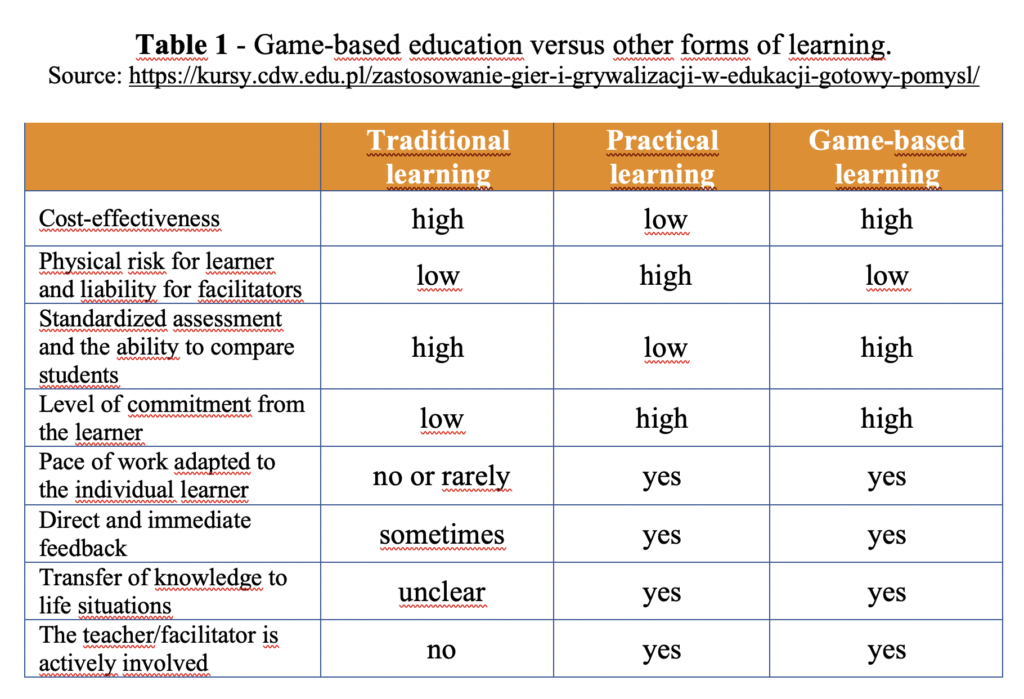
Why are games good/efficient/suitable in the educational sector? How can they be integrated into teaching? In Table 1 we compare game-based learning with the classroom-based education and with practice-oriented learning (meaning when the acquired knowledge and skills are applied to real-life situations, which is especially relevant for vocational education). As such, it is clear that game-based learning, if carried out correctly, can lead to many beneficial outcomes.
The Soft Skills Training Notebook: an innovative tool for implementation of the educational game in the classroom
The Soft Skills Training Notebook will be a key supporting tool for teachers in the implementation of the new educational game (‘Soft Skills Tree’) developed as part of the Playing 4 Soft Skills project. This Output, in fact, aims to provide teachers with a comprehensive manual explaining the game pedagogical approach and transversal skills targeted, provide guidance on the facilitator role and supporting material for the evaluation of participants. The Training Notebook will be developed in order to ensure that teachers participating in the educational game will be fully informed and well-equipped to effectively act as facilitators, conduct a careful evaluation of progress made by participants and contribute in fulfilling the project objectives.
The Soft Skills Training Manual will include, among others, the following elements:
– Pedagogical approach and learning objectives. This section will provide an overview on pedagogical and learning objectives linked to the educational game and will explore in detail the ways in which the game aims to foster the activation and development of transversal skills.
– Transversal skills targeted. This section will be based on the Soft Skills Evaluation Report and will comprise a clear definition of each soft skill, alongside with the set of parameters and indicators that teachers will have to look for during assessment of progress made by students.
– Teachers as Facilitators. This section will provide further guidance on the facilitator role by explaining in detail the procedures that teachers will have to follow in order to support students during the learning activity and to provide with valuable feedback on participants’ progress.
– Evaluation approach and supporting material. The final section will provide relevant information concerning the evaluation framework of the learning activity and with guiding material for teachers to use for their evaluation of soft skills activation in participating students.
The Soft Skills Training Manual, which will be available very soon, constitutes an innovative tool to be used across schools together with the new educational game developed by the project, and it will be available on the project website (www.playing4softskills.eu) for any teacher or education professional willing to implement the project results in the context of daily activities.